Why make a leash?
At Co-Op Survival, we recognize that making a dog leash is a fairly unconventional way to support disabled veterans and the families who care for them. And, before you tie that first knot, there is an element of trust— not much different than the level of trust a veteran or a caregiver would need. We are all starting on equal ground.
Equal Ground
Equal ground is rare in the veteran support space. More often than not, there is someone in charge offering a veteran or their family member help. No equal ground there, and, often, very little trust.
From that first step onto equal ground, leashmakers begin to find common ground, and common ground is where communities of support can grow.
It’s up to all of us
At Co-Op Survival, we reject the notion that reintegration into society is the sole responsibility of the Veteran; instead, we believe that society has a part to play in forming veteran-inclusive communities. As Thomas Berger noted in his 2008 Congressional comments on reintegrating veterans with post-traumatic stress disorder (PTSD):
“For PTSD the standard medical model is severely flawed because it only provides treatment in the hope of reducing symptoms and thus approximating some notion of “normality” – when in reality, “normal” is only a setting on your clothes dryer. Recovery exists, or can exist, within the context of the disorder. Reduce the stigma and discrimination, increase the clients’ social roles and participation, which provides them a reason to get better in the first place.” Thomas J. Berger, Ph.D https://www.govinfo.gov/content/pkg/CHRG-110hhrg43044/html/CHRG-110hhrg43044.htm
There is no roadmap
Mr. Berger did not include a roadmap for implementation, and his comments were specific to veterans who were suffering from PTSD, but his theory can benefit the veteran community as a whole.
Thankfully, we have found that no map is needed. When individuals meet on equal ground, when they listen to each other, and when they share their talents, communities of support emerge.
Bilateral Brain Stimulation
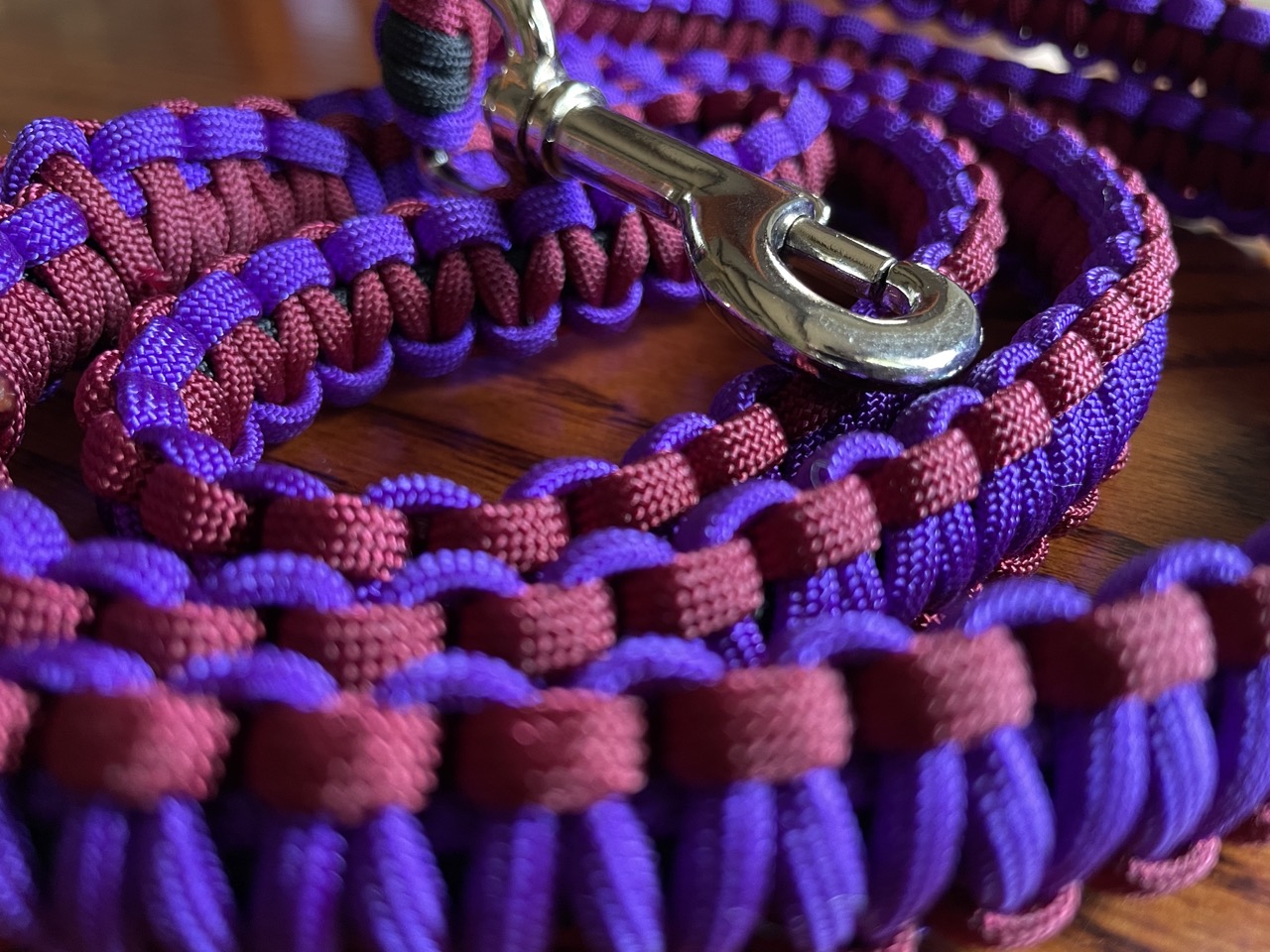
And, oddly, there is a physical benefit to leashmaking. Our leashes use what is known as a cobra knot. To complete one cobra knot, the leashmaker changes from right hand to left hand (the one you use to tie your shoe). After a few knots, your hands drop out of focus, but each knot does something amazing in your brain—bi-lateral brain stimulation.
In a study by the National Institute of Health (NIH), The Role of Alternating Bilateral Stimulation in Establishing Positive Cognition in EMDR Therapy: A Multi-Channel Near-Infrared Spectroscopy Study, researchers measured changes in oxygenated hemoglobin concentration, oxy-Hb, while test subjects experienced tactile BLS (touch rather than eye movement). During this change in oxy-Hb, subjects experienced a reduction of stress and an increase in pleasant memories. https://www.ncbi.nlm.nih.gov/pmc/articles/PMC5061320/
All of this is why you make a leash with us. It’s never about the leash.
Our goal
Our goal is to initiate conversations, not make leashes.
The leash is the byproduct of those conversations—not the goal—so we give the leashes to Veterans, service dogs, retiring military dogs, & first responders.
We never sell our leashes, but we do allow you to keep the first one you make.
Join us!
Together we will build strong communities of support, one leash at a time!