
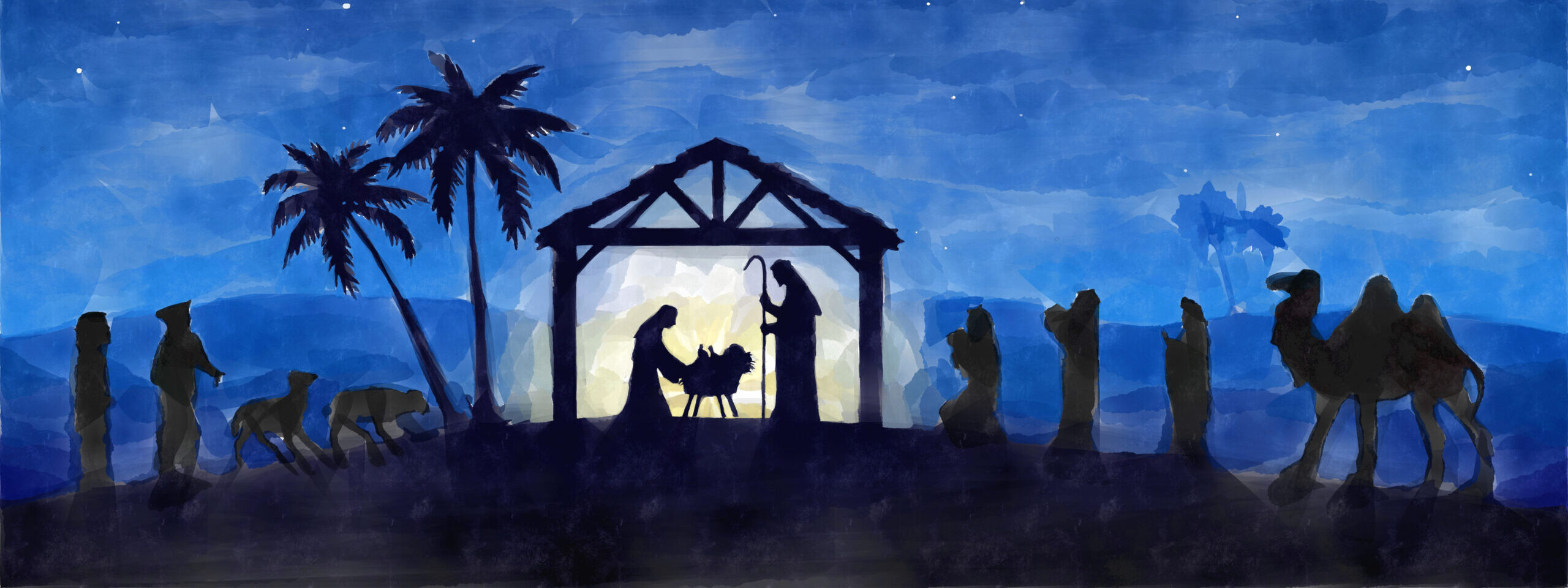
The Nativity – An unconventional family in an unconventional community
As you settle into your holiday traditions, stop for a moment and give the Nativity a second look (or maybe a first look). You can find a blow-up version in your neighbor’s yard, an organic version at your local church, or maybe a ceramic relic that someone’s grandma made. They are everywhere.
Breathe out preconceived notions, then see Mary and Joseph and as two unconventional parents and that menagerie of animals, shepherds, and wise men as the first members of an unconventional community of support. The child that brought them together wasn’t planned (at least not by them), wasn’t welcomed in traditional norms, and would most definitely change the lives of everyone involved.
About 12 years ago, my husband and I stepped into an unconventional family when we chose to care for our disabled-veteran son. The choice changed my career, our lives, our priorities, our friends, our home, and even our words (DOD and VA has its own language). Our choice was simple, but the consequences of that choice were complex, and we quickly realized that there was no star over our home to guide shepherds or wise men to our door.
As I looked for mentors and peers on this caregiving journey, I found support through organizations like the Defense and Veteran Brain Injury Center, the National Intrepid Center of Excellence, Wounded Warrior Project, and the Elizabeth Dole Foundation (EDF), and in 2018 I became an EDF Fellow. Through these communities of support, I began to realize that we are a veteran family, and, for a time, I believed that everyone understood that not all veteran families look the same.
Rather than understood, veteran-caregiving families are a misunderstood subset of traditional military families. The image of a warrior being carried off the battlefield has become an iconic call to support, but we somehow lose sight of the rest of the story. When a warrior becomes wounded, ill, or injured (carried off the battlefield), a sibling, a parent, a spouse, or a friend carries the veteran forward. During this transition, the roles and dynamics change for everyone in the caregiving family. There is no iconic image for this phase of the veteran’s life, but social norms place the married veteran as the head of a traditional family while the unmarried veteran seems to have none. This fallacy prevents rather than expands support for veteran-caregiving families.
Data could be the star that leads modern-day shepherds and wise men to the caregiver’s door, but caregiving families and military families are seen as one data set. Unconventional families are excluded from military family and transitioning veteran research, which leaves gaps in the veteran-family experience. Veteran-caregiver research is inclusive and could fill the gaps, but it is often used to validate traditional-family programs rather than expand unconventional-family programs.
When the data that defines the needs of military and veteran families has gaps, programs fail. Programs that address military- and veteran-family employment, such as career portability, federal hiring, and transitional assistance, do not recognize veteran-caregiving families. At the community level, grants and local giving programs lack guidance for veteran-caregiving families. And addressing this poorly defined category of veteran families is not easy. The Biden administration attempted to address this gap at the federal level in EO-14100, which instructs the office of personnel management (OPM) to add caregivers into federal programs. In response, OPM added the word caregiver to the title of their military-spouse hiring programs — not a fix.
When a disabled veteran needs a service-dog, we don’t tell them that chihuahuas and doodles are off the list; the dog fits the needs of the veteran and not our need for social normalcy. In choosing family support, let’s not place social norms in the way of what is best for the veteran; and please don’t say that their unconventional family is not actually a family. The reality is that 50% of post-911 service-members were not married, 75% of disabled veterans live in an unconventional family, and all veterans deserve our respect. Our goal should include understanding and support for military families, veteran families, and caregiving families. Each type of family has needs that we can support, and it is up to us to listen to them, see them as they are, and welcome their families into our community.
Take another look at the Nativity. It’s no accident that everyone is staring at baby Jesus. When our focus is on the child, the rest falls into place. God dropped His only son into an unconventional family, and that family found support from an unconventional community. He believed that a bunch of flawed humans and sweet animals would know what to do, and I believe that too.
Bio:
Sharon Grassi is the President/CEO of Co-Op Survival, an organization that builds communities of support for disabled vets and brings veteran caregivers together to rebuild the stories they tell themselves.
Sharon is an Elizabeth Dole Fellow/alum, a UMGC master’s student (strategic communications) and Pillars of Strength recipient. She and her husband, Peter Grassi, live in Arizona, have four children, three grandchildren, and a care for their 100% disabled-veteran son, Derek Tope.