
Norma & Jack
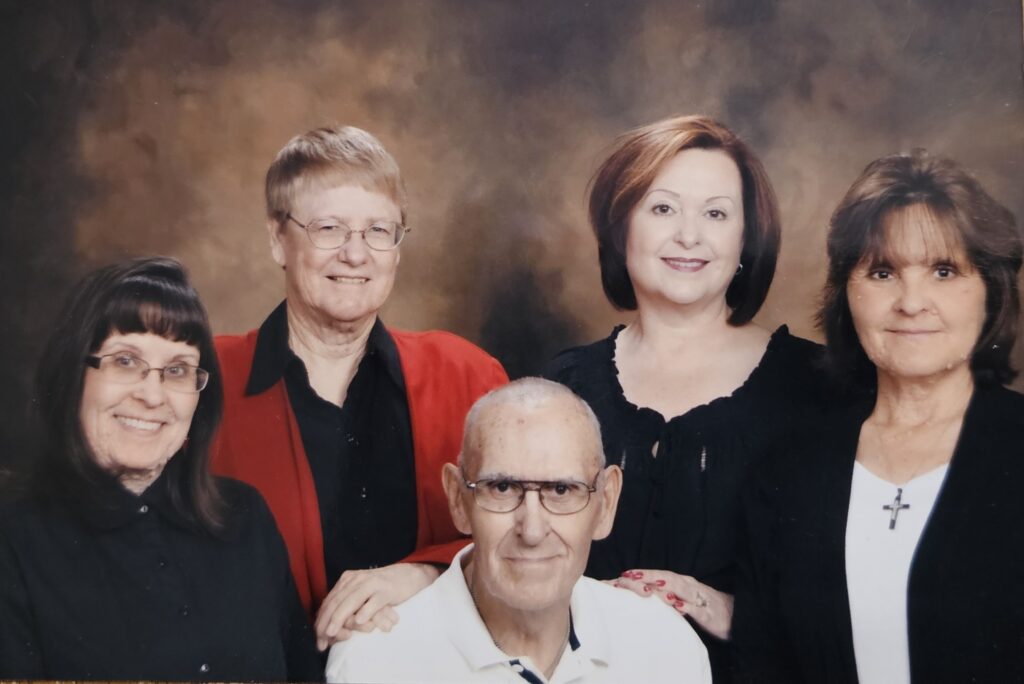
Norma and Jack met during the Vietnam conflict while they were both in the Air Force, and like many service-members from the Vietnam era, they wasted no time in getting married. They jumped in Jack’s Buick, headed to Lawton, Oklahoma, and got married just a few weeks after they met. Norma told her mom about the wedding the next day — her mother was not pleased, but she learned to love Jack over the years.
Jack
When they met, Jack was a jet engine technician who was luckier than most; he’d seen combat in Vietnam and made it home, but not unscathed. At one point, he refused a purple heart to save his mother the heartache of getting word that he’d been injured, and other injuries were ignored because he had mouths to feed; it was just easier to get over the injuries and move on. After 20-years in the Air Force, and just a few months after they married, Jack retired.
Norma
Norma’s Air Force career as a COBOL Programmer was just taking off when they met, but marriage to a man with three children changed her priorities. When the Air Force handed Norma a transfer to Okinawa, she filed for a hardship discharge, severed her military career, and their new family headed into uncharted territory.
Unprepared
Neither Jack nor Norma were prepared for the impact that Jack’s injuries would have on his ability to work. Jack’s body was damaged, the girls were practically adults, Norma’s service was all but forgotten, and by the time Norma was thirty she was the breadwinner in the family. Their transition from a military family was abrupt and without support. Had the military addressed Jack’s injuries, someone might have noticed that Norma and Jack could use some help, but this was 1971 and Vietnam vets got very little support.
In Norma’s words
At this time in our life Jack was unable to keep a job because his back was often out. He had his retirement pay but I was unaware that he could have applied for disability benefits. When he was discharged, he was told that if he applied for disability for his back that they would fuse it. He was a mechanic and was not going to get his back fused. We didn’t live near a VA so I wasn’t aware of any help that might have been available. Our biggest stress at this time was financial.
The consequences of war
Heart disease from agent-orange exposure was the next health-crisis for Jack, so Norma cared for him while she fought her own health crisis — breast cancer. They adjusted their work/life balance, maintained their dreams, downsized, and traveled the country in a motor home until Jack couldn’t drive anymore, then they adjusted again. A few years later, Norma came home to find that Jack had taken apart the deadbolt to their front door. He’d locked the front door with no way to unlock it and was now attempting to rewire the house. Jack had vascular dementia, most likely from one of the many concussions (traumatic brain injury (TBI)) he’d experienced while on active duty. Jack was not going to get better, his health would degrade, and eventually his brain would stop telling his organs to function.
Jack’s injuries
TBI is the oldest form of illness that can be found in human history. Think about any caveman cartoon you’ve ever seen; there is a club, a caveman, someone gets hit over the head, falls over, then gets back up again. Today, we frown on hitting each other over the head, but our military is required to walk into situations where 23% of them are likely to incur at least one mild traumatic brain injury (mTBI), or what is better known as a mild concussion, getting your bell rung, or seeing stars. We build better helmets to prevent our military from dying on the battlefield, but the best helmet can’t prevent brains from jiggling like a well-shaken martini when the shockwaves of a blast hit. In Jack’s case, his brain experienced multiple TBIs during his 20s and 30s, which increased his risk of dementia by 2-4 times.
Bureaucracy
Norma knew that Jack’s injuries were a result of his time in the military, and she had the documents to prove it, but, at the time, a wave of post-911 vets were bogging down the system. So, Norma did the best she could while appealing every denial for VA care and support. For years, Norma watched Jack slip farther-and-farther away from her while she skimped and saved every penny, rarely leaving the house to care for herself. Her only hope was that someone would finally recognize that Jack’s service injuries were connected to his current health crisis, so she filled out forms and worked with Veteran Service Organizations, and they finally won. With a huge sigh of relief, Norma stopped worrying that caring for Jack would eventually make her homeless.
Unmet needs
Jack and Norma were still a traditional family, but their day-to-day reality was that of a veteran-caregiving family — an unconventional family. They were still married, still had children, but their needs could not be met in the same way that a traditional family’s needs were met. Jack needed someone to care for him, Norma was doing just that, but neither of them were getting what they needed from veteran support networks.
In Norma’s words
I needed help finding resources but often found we didn’t qualify for those resources because his disability rating was not high enough, he was not post 9-11, or we had too many assets to qualify. I needed to be assured I would not be destitute after paying for Jack’s care. I was expected to be alert and available 24 hours a day because I never knew what Jack would try to do at any time of the day or night and could not afford to have someone else come in and provide assistance or respite because I knew that eventually he would need 24/7 care and that could bankrupt me. Aid and Attendance is means tested and we would not qualify until our assets were used up and I was saving for the future need for a care facility. I was exhausted and losing all social connection.
I needed a support group but couldn’t leave Jack alone and had no one to leave him with. I needed to see a light at the end of the tunnel and all I saw was myself being buried in debt, or, maybe just buried – some studies show that caregivers of a person with dementia have a 63% greater chance of dying before the person they are caring for.
I needed sleep. I needed alone time. I needed social connection. I needed an advocate. I needed financial security. I needed a support group. I needed hope.
Caregiver legislation
In 2010, the Caregivers and Veterans Omnibus Health Care Act insured support for family and friends who care for a disabled veteran, and the VA developed the program of comprehensive assistance for family caregivers (PCAFC) in response to the 2010 law, but the VA did not apply their new caregiver program to all eras; instead, they rolled PCAFC out in blocks, with the post-911 era coming first. The Vietnam-era vets took a back seat and waited, and waited, and waited… Again. Jack finally had the care he needed, but Norma had none.
In the end
In the early hours of a starlit fall morning, Norma laid her hand on Jack’s hand and watched him slip away. Jack’s life ended the day after Veteran’s Day, 2021, when his brain stopped telling his heart to beat and his lungs to breathe in air. Jack’s wounds were invisible wounds — invisible to everyone but he and Norma. For Jack and Norma, they were real wounds with very real consequences. And Norma, his caregiver for over 50 years, was now alone.
The data
There are 14.3 million veteran caregivers in the US. What the data will tell you, is how we are defined by military conflict, gender, socio-economic status, relationship to the veteran, and much more. The data categorizes, slices, dices, and mixes the caregiver population, but it can never tell you what it’s like to build hope after moral injury, give space to a victim of sexual trauma, or hold the hand of a veteran dying from toxic exposure. Data can’t describe this protective, giving, loving, smart, tough, tenacious, and dedicated group of humans, who rarely have much in common but our love of our disabled veteran.
+1
At the time that Jack died, Norma was still not recognized as his caregiver by the VA. Caregivers, like Norma, give up careers, retirement benefits, social security benefits, and, when their Veteran dies, they lose a majority of what little money their Veteran received for injuries incurred during their service to our country. And, too often, they wade through a bureaucratic pile of regulations to get what little they deserve when their “job” is done.
When a family member agrees to care for a veteran, they step into the veteran community as a +1 to the veteran they care for, and when their job is done, too often, they have no place in the communities that once supported them. That is devastating for the caregiver and the veteran-caregiving family. In Norma’s case, she had chosen to be a veteran, a military spouse, and an educator, but Norma didn’t choose to be a caregiver, at least not in the sense that this was a job she wanted. Her transition to caregiver meant that she now placed Jack’s medical needs at the center of every decision, and now that he was gone, she was no longer a +1. At least in the demise of a marriage there is a designation of ex-wife or widow, but in the veteran support space, caregivers just disappear.
In Norma’s words
When Jack passed, I did not know where to turn. I was summarily dismissed from the general caregiver support program (which the VA had finally opened to the Vietnam era) because I was no longer the caregiver, and I was not directed to any resources that could help me navigate the VA and DFAS for benefits. I was not made aware of TAPS as a resource available to me. I had to find out for myself how to get approval for his burial in a Veteran Cemetery and how to get an honor guard. I had to provide proof that his death was directly connected to his service-connected disability because he had only been 100% service connected for 6 years not the ten years required for a spouse to automatically collect DIC.
When I most needed a shoulder to cry on and direction for how to navigate life after my veteran’s death I encountered a void. I needed grief counseling. I needed a friend, an advocate, a connection. I needed not to be dismissed by the VA simply because the veteran they were treating had passed. I needed to know that someone cared for me too.
Why does this matter?
Too often, organizations that support military and veteran families do so based on a traditional-family model — dad, mom, children — which excludes support for approximately 75% of veteran-caregiver families.
- In the traditional-family model, parents are married, the veteran transitions from a military job to a civilian one, the military spouse transitions from constant moves to a civilian community and a civilian job, and kids spend time with their peers.
- In the veteran-caregiver-family model, the veteran does not go back to work, the caregiver cares for the veteran and hopes to find an employer that will allow them to flex time or telecommute, and children give up time with their peers while filling in the gaps of caregiving.
How can you help?
You are reading this, and that is step one.
Step two: Know the difference between a military spouse and a family member who is a caregiver for a wounded, ill, or injured veteran.
Step three: Add veteran-caregiving family to your vocabulary.
Step four: Find a veteran-family caregiver in your family, your neighborhood, your school, or your workplace and say, “Thank you!”
Step five: Listen to them.
Step six: That’s up to you.
Author, Sharon Grassi
Sharon Grassi is the President/CEO of Co-Op Survival, an organization that builds communities of support for disabled vets and brings veteran caregivers together to rebuild the stories they tell themselves.
Sharon is an Elizabeth Dole Fellow/alum, a UMGC master’s student (strategic communications) and a Pillars of Strength recipient. She and her husband, Peter Grassi, live in Arizona, have four children, three grandchildren, and a care for their 100% disabled-veteran son, Derek Tope.