
Mary and Tom
A story of love, resilience, and transformation
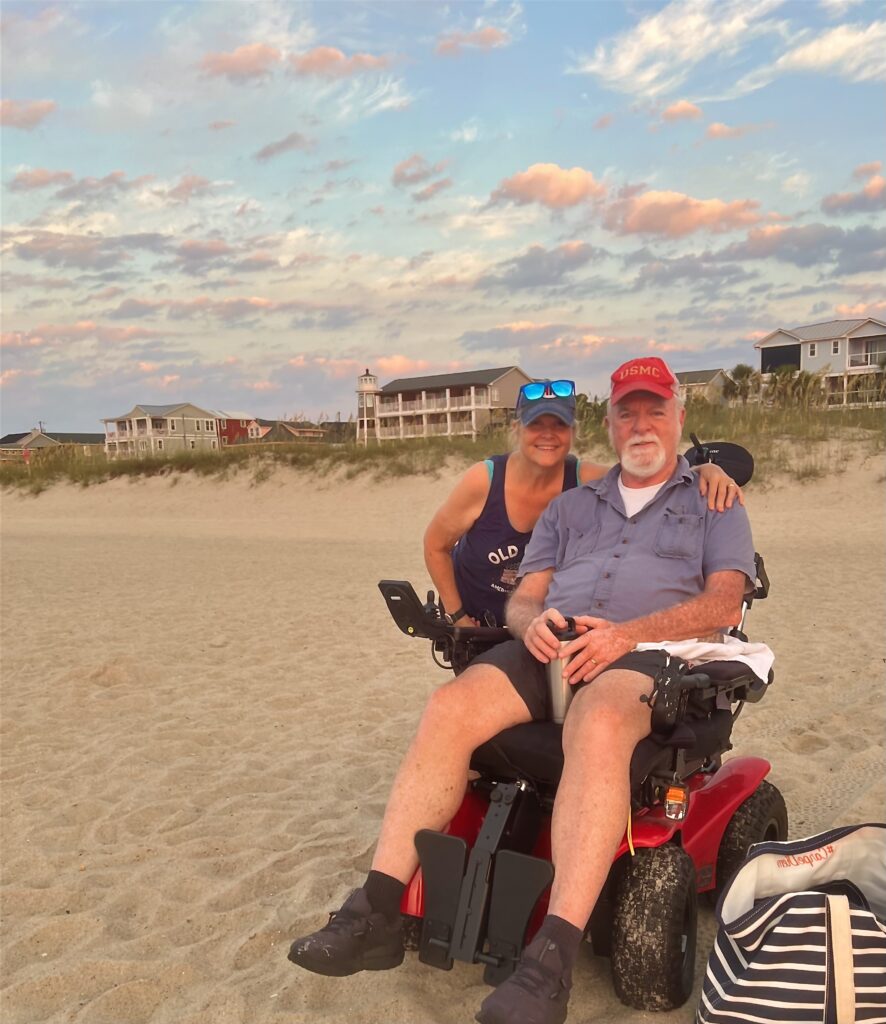
Mary
Quietly, she spends each morning in a bedroom that she transformed into a studio. The rest of the house is open to any number of visitors, clinicians, aids, and family, but this space is hers; just hers. Slowly, she makes her way through her morning vinyasa; taking her time, finding her rhythm, and savoring the control that she has over this tiny part of her day. The sun hasn’t risen, the moon is gone, and butterfly lights twinkle until the morning’s twilight peeks in. It is in this space that Mary disappears; where words leave her and her creativity returns. It comes to her in her choices of color, in the complexity of materials, and the seemingly disconnected bits of debris that her hands bring together to form beautiful paper—her art. Sometimes she adds a bit of lavender from her garden, or she may decide on a brightly colored thread that runs through her design. Whatever it is, she’ll hold the choice in her heart, ready to share her ideas with Tom over their morning coffee. It’s in their conversations of color and the play of light that they return to that first afternoon.
Where it started
It was St Patrick’s Day, 1979, and Mary decided that she was going to meet the cute guy in the aviator sunglasses who was sitting at the front of her Long Island community-college geometry class; the one who seemed to be completely unaware of her. His short hair and manners stood out, and she knew there was something more to him. Her choice to sit in the back of the class was a strategic move to avoid being called on, but she picked up her books, walked to the front of the class, and took the seat next to Tom. A few minutes later she leaned in and checked out his paper. Just as she’d hoped, Tom made the next move—a coffee date after class that lasted through the rest of the day. Tom proposed 30 days later, and they were married 15 months after the proposal. From that first cup of coffee, they both knew that they were meant to be together.
Tom
Mary was right, there was more to Tom. At 17, Tom headed to Parris Island for boot camp, fulfilling his lifelong dream to become a Marine. It was the early 70’s, and our country was still reeling in political turmoil, but politics was never his concern, he just wanted to serve his country as a Marine. While enlisted, Tom spent time in the Fleet, deployed to Guantanamo, trained in Panama for Special Missions Force jungle warfare, and spent close to 14 months at Camp LeJeune. When his time in the military was done, Tom headed back to Long Island, his hometown, and took a few odd jobs before heading back to college. By 1979, he was sitting at the front of Mary’s geometry class.
Just a conventional family
When they married, Tom was a veteran, Mary became a veteran spouse, and neither of them gave the military much thought. They were a family, just like any other family. They worked hard, had fun, loved fully.
By 1992, they’d settled into a beautiful home in Cornwall, New York, with their son, Sean, and daughter, Kate. The kids had their own backyard, Mary was back in college, and every day after work (an hour drive, subway ride, full workday, and return home) you could find Tom playing with the kids, working in the yard, or fixing up the house. Tom loved to stay busy, and their life kept him very busy.
Sadly, their hard-earned bliss was short lived. Tom developed encephalitis, leaving him with executive-function impairment. Home improvements were confusing, he’d get lost on his way home, and, eventually, the couple accepted that Tom would never work again.
Mary was 33, Tom was 38, and encephalitis had nothing to do with Tom’s military service. The couple navigated Tom’s complex medical needs, and Mary, unknowingly, became his caregiver.
The Choice to Care
For me the essence of gratitude is most deeply honored when I can give of myself to someone else. Caring for Tom, and our family, is the deepest form of gratitude.
Without a degree, Mary could never hope to cover all their bills, so their family lived frugally while she finished her bachelor’s degree. After graduation, she took a part-time position at a small community hospital. The position gave her enough flexibility to navigate the complexities of Tom’s health and deal with the time-consuming details of disability insurance. Over the next decade, she cared for Tom, raised their two children, finished two additional master’s degrees, and rose to the level of program director for the elderly at their local hospital.
I had a ton of personal growth throughout this whole process, and much of that growth was supported through the tolerance and understanding of the managers I worked with. Although I was a part-time employee for the community hospital, my manager would consistently get me to 37-hours a week, and, by law, that meant I had full-time benefits. I was always willing to do the work to make sure my kids and Tom had what they needed, and sometimes that meant scraping together enough funds to buy Tom painting supplies. Tom had begun a lifelong journey into learning to paint. He took lessons. He worked diligently at it, and over the years became quite good at it. Painting became the one thing that provided Tom with a path to move forward.
A Nation Chooses to Care
While Mary was juggling work and caregiving, President George W Bush was developing a caregiving program for veterans; although, he didn’t know it yet. Bush-2 wondered how wounded, ill, and injured service-members could return home. His concern led to the Commission on Care for America’s Returning Wounded Warriors, with Senator Bob Dole and HHS Secretary Donna Shalala heading the commission. Work from the commission led to the Caregivers and Veterans Omnibus Health Services Act of 2010 and laid the groundwork for the Program for Comprehensive Assistance for Family Caregivers (PCAFC). With the support of a family caregiver, post-9/11 veterans with catastrophic wounds could return home.
The Transition to Veteran Caregiver
I would have liked it if someone had handed me warmth rather than a social-worker’s brochure that came with, “here’s your terminal diagnosis.
In 2010, the distance between civilian and military life was about to change for Tom and Mary. Tom’s symptoms worsened, and he was diagnosed with Amyotrophic Lateral Sclerosis (ALS); a VBA presumptive condition. Presumptive means that the disease is more-likely-than-not (VBA benefits term) the result of the veteran’s time in service. In Tom’s case, he assumed that he was unaffected by his time in service, but his diagnosis places him in a category of veterans who are contracting ALS at a higher rate than the civilian population. Tom’s ALS was quickly connected to his time in service, but, at the time, ALS was a 30% rating, which amounted to a few-hundred dollars per month and limitless battles with VA administrators.
I’ve been Tom’s caregiver longer than the years that I was just his wife. We will be celebrating our 46th anniversary in June of this year. From 1993 to 2010, I cared for Tom. Not once in all of those years did I consider myself a caregiver. I didn’t deny it. I just didn’t think about it. I care for him because I love him. In the civilian healthcare system, I was never denied the role of advocacy for him. In the VA system, there were, at times, some difficulty with being his advocate. Most importantly, the VA had a support program for caregivers of those who were wounded in the post 9/11 conflict. Pre-9/11 caregivers were specifically not included. From a VA perspective I didn’t have access to support to assist in grappling with my husband’s terminal diagnosis. It would be years before that changed.
Veteran Advocacy
Frustrated, not just for Tom but for all vets with ALS, Mary addressed the VA’s shortsighted decision to rate ALS benefits at 30%. So, while teaching Social Studies and caring for Tom, Mary added veteran-advocate to her list of skills. In 2011, she wrote a letter to every congressman and senator, explaining that ALS is a terminal disease with a three-to-five-year life expectancy. While dying, veterans had to, repeatedly, request increases in benefits. It wasn’t long before Mary received a call from Senator Burr’s office. Burr’s staffer let her know that everyone in congress was talking about her letter. With Mary’s help, ALS benefits were finally rated at 100%.
Some of the things that kept me sane were the connections I’ve made with other caregivers of ALS patients.
Foundational Veteran-caregiver Advocacy
As Mary advocated for veterans with ALS, another notable veteran spouse realized that family caregivers needed an advocate too. During her husband’s (Senator Bob Dole) 11-month stay at Walter Reed, Senator Elizabeth Dole met with countless family members who were caring for wounded service members. Taking action, Senator Elizabeth established a platform for caregiver advocacy; a place where veteran caregivers can be seen and heard—the Elizabeth Dole Foundation.
Elizabeth Dole Fellow
In 2016, the Elizabeth Dole Foundation took notice of the work Mary was doing and asked her to become an Elizabeth Dole Fellow. As a Fellow, she’s worked on many projects and shared her story with community members, caregivers, and legislators. Her testimony at a VA Senate-oversight meeting shed light on the barriers that denied pre-9/11 caregivers access to PCAFC and helped legislators understand the importance of the VA’s caregiver programs.
Caring for veterans of all eras
A decade after the inception of the VA’s caregiver program, the Mission Act of 2018 demanded PCAFC access for veteran-caregivers of all eras. Two years later, the VA published PCAFC’s Improvements and Amendments Under the VA MISSION Act of 2018. Finally, Vietnam-era veterans could request support for family caregivers who had been caring for them; often, for decades. Mary was approved as a PCAFC caregiver, and life got a little easier.
It can be burdensome, at times, to be so connected to Tom in terms of his ALS and me being his caregiver. It shifts into my identity as well. I am so much more than that as a human being.
Today
Today, Mary is a respected leader in the veteran caregiving community. While her primary focus is the ALS community of veterans and their caregivers, I know Mary as a caregiver who epitomizes the cliché that we caregivers hear so often, “Put on your own mask before you help someone else.” We are no good to anyone if we can’t learn that simple truth.
Growth happens from one minute to the next minute, throughout the entire journey, and that entire journey is important. Growing is so important, and there are times when you are so deep in what you are doing that you don’t know that you are growing while at the same time sweeping your previous experiences behind you. It is so important to give yourself some credit for how far you’ve come so you can move forward. How would I have ever decided to make paper instead of writing and taking photos, where I used to find my peace. Writing became a lonesome place that I couldn’t bear, and photography… I can’t get out enough to make it happen anymore. Papermaking is dynamic and interesting and opens my world to a community that fills me, a physical world that includes people I can reach out to, including Tom. And the imperfection of it draws me in; it allows me to find the essence of my self-care, and a way to leave the title of caregiver out of my vocabulary. Often, we say that we need self-care to be better caregivers, but I say that I need self-care to be a better Mary; to maintain myself, my identity. Without that, I lose the essence of who I am.
Their Art
You can see and/or purchase Mary’s and Tom’s art at their online store:CottageatMarehaven.com

The Transformation
The day before wounds, illnesses or injuries, family caregivers have lives full of children, careers, hobbies, and personal interests. Their social identity is a function of individual choices, age, gender, family connections, career paths, academic success, and financial status. And prior to becoming a caregiver, there was little common ground between the parent of a soldier, the sister of a sailor, the brother of a marine, or the wife of an airman.
The day after wounds, illnesses or injuries, family caregivers begin a journey towards common ground. While life moves forward, caregiving can become their dominant social identity, if not by choice, by necessity.
This transformational shift in social identity can negatively impact the caregiver and the veteran.
At Co-Op Survival, we believe that communities of support can reduce the impact of this transformation.
What you should know
Too often, organizations that support military and veteran families do so based on a traditional-family model — dad, mom, children — which excludes support for approximately 75% of veteran-caregiver families.
- In the traditional military-family model, parents are married, the veteran transitions from a military job to a civilian one, the military spouse transitions from constant moves to a civilian community and a civilian job, and kids spend time with their peers.
- In the veteran-caregiver-family model, the veteran rarely goes back to work, the caregiver (spouse, a parent, a sister…) cares for the veteran and hopes to find an employer that will allow them to flex time or telecommute; children who live in the home (many are not the child of the veteran) give up time with their peers while filling in the gaps of caregiving.
How can you help?
You are reading this, and that is step one.
Step two: Know the difference between a military spouse and a family member who is a caregiver for a wounded, ill, or injured veteran.
Step three: Add veteran-caregiving family to your vocabulary.
Step four: Find a veteran-family caregiver in your family, your neighborhood, your school, or your workplace and say, “Thank you!”
Step five: Listen to them.
Step six: That’s up to you.
Author, Sharon Grassi
Sharon Grassi is the President/CEO of Co-Op Survival, an organization that builds communities of support for disabled vets and brings veteran caregivers together to rebuild the stories they tell themselves.
Sharon is an Elizabeth Dole Fellow/alum, a UMGC master’s student (strategic communications) and a Pillars of Strength recipient. She and her husband, Peter Grassi, live in Arizona, have four children, three grandchildren, and a care for their 100% disabled-veteran son, Derek Tope.